What We Learned Building a VR Exam Neither of Us Could Build Alone
September 22, 2026
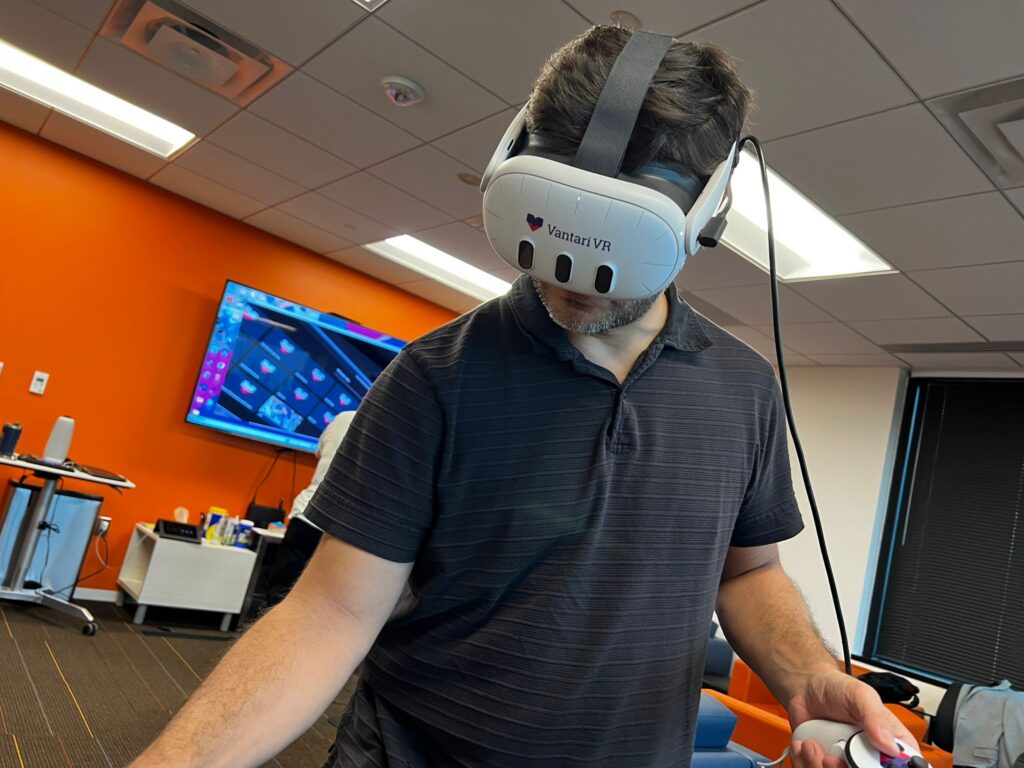
A standards organization and a VR platform company on the 50/50 model behind a scalable ultrasound education program — and what it actually takes to make that kind of partnership work.
Executive Summary
Neither a standards organization nor a VR platform company can build a defensible, scalable, ultrasound VR education program informed by credentialed subject matter experts on its own. Not simply because of resource limits, though those are real, but because the two halves of the problem require genuinely different expertise. One half is clinical and psychometric: knowing what competence actually means, task by task. The other half is technical: building an environment that can capture and score performance reliably, across cohorts, at a scale no single standards organization could support on its own. The interesting story isn’t that we partnered. It’s what a partnership has to get righ
The product itself reflects the split plainly: Inteleos owns the clinical and competency content; Vantari VR owns the platform. That division didn’t happen by default. It happened because each side tried, at different points, to imagine building the other half, and concluded it shouldn’t.
The model is also, deliberately, not a one-off arrangement. Inteleos has described it publicly as a template other credentialing bodies could use: translate your competency standards into a scalable virtual assessment, deliver formative and summative evaluation in one environment, and do it through a content-owner / platform-developer partnership rather than trying to build the technology in-house.
Access to skilled care is limited by the supply of people qualified to teach and assess it — and a standard that can travel expands that supply. That’s what makes this work matter beyond the two organizations that built it, not the technology itself.
What follows is what we’d tell another pair of organizations before they sign a similar agreement — including the one lesson that had nothing to do with clinical content or engineering at all: getting communication and project management right between two very differently structured teams.
Two Kinds of Expertise, One Product
A hands-on clinical skill, the kind that has historically only been assessable in person, by an expert proctor or instructor, doesn’t necessarily translate into something that can be validly and defensibly assessed just because it’s rendered in a headset. It becomes one because specialists with deep psychometric and clinical-content expertise defined what “competent” actually means, task by task, and other specialists with deep platform and engineering expertise built an environment that can capture and score that performance reliably, at scale.
From Inteleos’ side, that meant clinical content ownership grounded in an existing credentialing infrastructure: subject matter expert networks built over years; a scoring and validity discipline shaped by decades of traditional psychometric work; and staff who could translate a clinical competency standard into something a VR environment can actually implement. That work broke competence down
At the core of this experience is Vantari’s dynamic ultrasound imaging system. This technology enables real-time, 1:1 correlation between the movement of a virtual ultrasound probe and the corresponding image displayed on the ultrasound console, achieved by replicating the acoustic properties of human tissue within the virtual environment so that every probe movement generates a correlating, anatomically accurate ultrasound image in real time. Bringing this to life required a two-year development effort in partnership with Inteleos subject matter experts to validate correct anatomical placement and ultrasound-specific visualization, including bone shadowing, acoustic grayscale imaging, nerve artifact, fluid visualization, and animated cardiac motion. This investment allowed Vantari to deliver true-to-life, best-in-class image quality at high frame rates, while retaining the ability to fine-tune anatomy shape, size, and position for accuracy. Most importantly, this approach lets Vantari develop new pathologies and varied patient body habitus on top of the same underlying tissue and anatomy model rather than building each patient from scratch, giving the platform the ability to scale content efficiently and publish new modules that map directly to evolving training curricula.
Vantari also built a true-to-instructor scoring system with Inteleos that validates trainee performance the way a real instructor would: first, whether anatomical landmarks are captured correctly; second, whether the image is optimized through proper depth and gain; and third, whether measurement calipers are positioned in an optimal manner. Each of these grading criteria is reflected as a real-time green or red check in the UI, giving trainees immediate, objective guidance as they scan.
To support this level of realism, Vantari built a fully immersive ultrasound scanning room that addresses one of the industry’s biggest training gaps: ergonomics. The environment replicates true-to-life patient bed positioning, console positioning, and interaction with a virtual ultrasound console, allowing trainees to adjust depth, gain, and angle, use the scroll wheel to position calipers, and freeze, unfreeze, and cineloop the image just as they would on real equipment. Every captured image and performance metric is transmitted in real time to Vantari Connect, Vantari’s learning management platform, where educators can create assignments, review trainee performance, analyze cohort trends, and answer student questions in one centralized experience, while trainees can review their in-headset performance and ask instructors questions directly.
A standards organization that tries to build the platform, or a platform company that tries to own the clinical standard, ends up with something neither side can defend under scrutiny.
What the 50/50 Model Actually Requires
The IP split — content owner, platform owner — is simple to state and harder to operate day to day. Two organizations with different sizes, different incentives, and different constraints have to agree, repeatedly, on questions neither side can fully answer alone: what fidelity is worth building, what timeline is realistic given finite dedicated engineering resources, and who has final say when a clinical requirement and a technical constraint pull in different directions.
The friction we can point to directly was less about the clinical content or the platform itself, and more about how two organizations actually work together day to day: communication and project management. Early on, requests and feedback ran through a small number of designated contacts on each side, which meant Inteleos staff with a direct clinical question often had to wait for it to be relayed to a developer rather than asking directly — slower, and more prone to something getting lost in translation between a clinical requirement and a technical spec. Getting past that took real trust-building, not just a policy change: both teams had to become comfortable with Inteleos staff and Vantari developers talking to each other directly, without every exchange being routed through a single project lead.
The same was true of tooling. Punch lists — the running record of what needed fixing, building, or reviewing next — didn’t have an obvious shared home at the start, and the two organizations didn’t default to the same systems. What worked wasn’t finding the one “right” platform from the outset; it was both teams being willing to try different tools and adjust when something wasn’t working, rather than each side insisting on its own existing system out of habit. That willingness to experiment together, on something as unglamorous as project management software, turned out to matter as much as any clinical or technical decision in the project.
The broader practices that followed from that experience are structural, not just relational. Write down what each party owns and decides alone, and what they decide jointly. Tie the review cadence to real milestones, not the calendar, so tension surfaces early. And — as our own experience made clear — be willing to change how you communicate and which tools you use.
Key Questions This Piece Addresses
Why can’t the standard owner just build the platform in-house, or a platform vendor just own the clinical standard?
Because the two halves require different expertise that takes years to build. Clinical and psychometric credibility comes from running certification programs and defending assessment decisions with volunteer SME committees; platform credibility comes from engineering a system that performs reliably across users, hardware, and scale. Neither skill set substitutes for the other.
What does a 50/50 IP partnership actually require to function well?
A written, specific definition of ownership, decision, and revenue rights from the start; a review cadence tied to real milestones rather than the calendar; and an agreed process for resolving priority conflicts before they arise — not worked out for the first time under deadline pressure.
Is this model replicable for other credentialing bodies and other procedural skills?
Yes, with real preconditions: the standard owner needs clear ownership of its content and reliable access to subject matter experts, and both parties need a realistic shared timeline that accounts for the platform partner’s actual dedicated capacity, not an assumed one.
A Closing Note From Both Sides
For us, this partnership was never really about two companies figuring out how to work together, it’s about what becomes possible for healthcare workers and patients when a standards organization and a technology company commit to solving the same problem from both ends. Inteleos brought decades of knowing what competence actually means, task by task. Vantari brought the ability to put that standard in front of any ultrasound trainee, anywhere, without a manikin, a proctor, or capital equipment. On their own, neither of those things closes the gap in healthcare training access. Together, they mean an ultrasound trainee in a rural technical college in Wisconsin can train and be assessed against the same standard as someone at an urban state of the art university in Seattle. That’s what made this worth building, and it’s why we’re already asking what standard we should build together next.
This post was created with the assistance of artificial intelligence (AI).
Related Thought Leadership


Get in Touch
Reach out to learn more about Inteleos and our communities
"*" indicates required fields